Written by AJ Services Group | Published on June 2025
An industrial electrician installs, maintains, and repairs the high-voltage electrical systems, control panels, motors, and automated equipment that keep commercial and industrial facilities running across Sydney, Australia. Unlike a residential electrician who focuses on homes, an industrial electrician works with three-phase power, programmable logic controllers (PLCs), and heavy machinery.
This guide covers the core responsibilities of an industrial electrician, how their work differs from commercial electrical work, what qualifications NSW law requires, and how to know when your business needs one. If you run a factory, warehouse, food processing plant, or large commercial facility in Sydney, this guide is written for you.
Understand the Core Responsibilities of an Industrial Electrician
Industrial electricians handle a broad range of tasks that go well beyond basic wiring. Their work keeps production lines moving, prevents costly downtime, and ensures your facility stays compliant with Australian safety standards.
Here is what a qualified industrial electrician does on a day-to-day basis:
- Install and commission three-phase power systems for heavy equipment
- Wire and program PLCs and SCADA control systems
- Maintain and repair electric motors, drives, and variable frequency drives (VFDs)
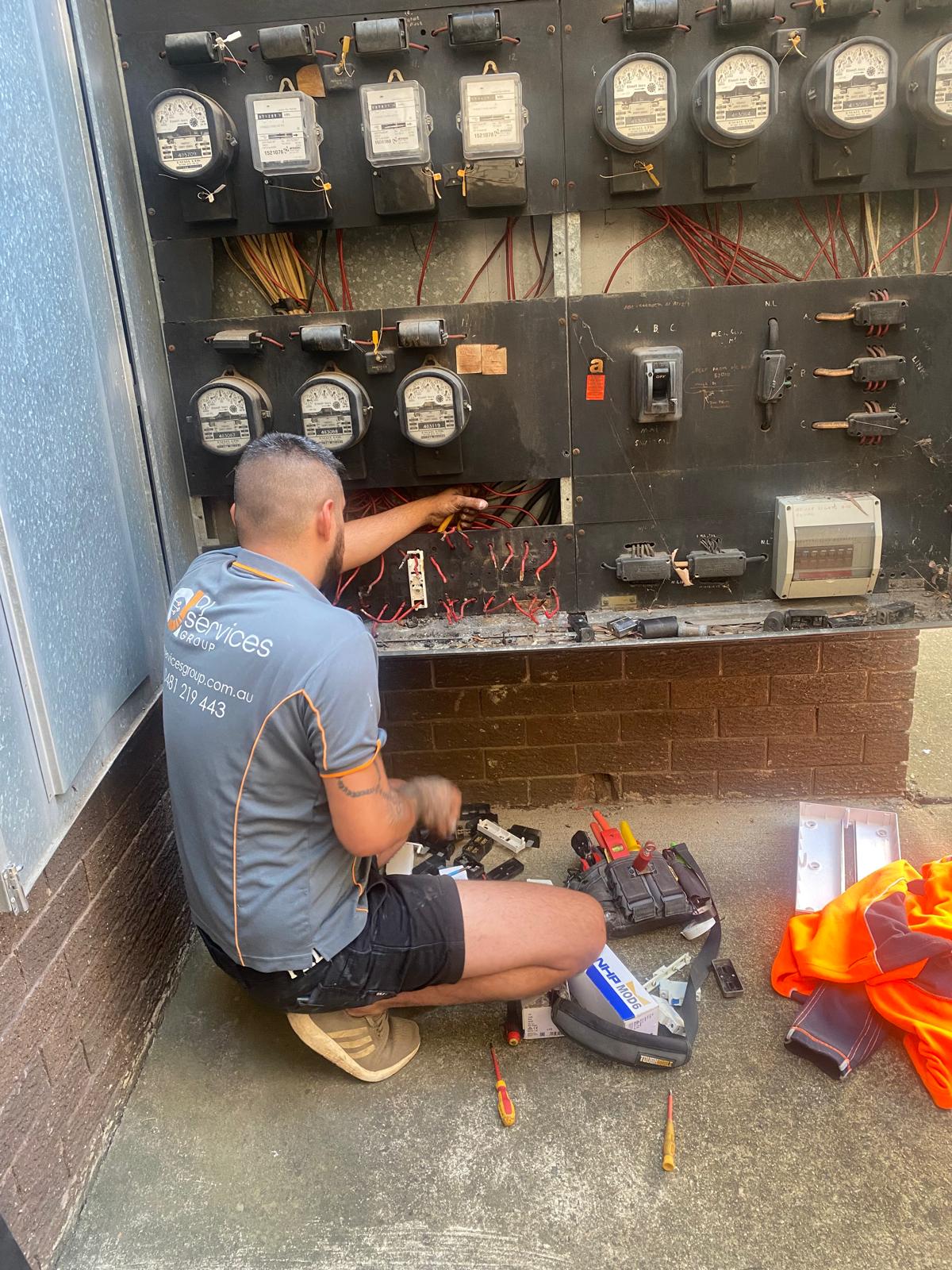
- Inspect and upgrade high-voltage switchboards and distribution boards
- Fault-find electrical failures in automated production systems
- Install lighting systems including industrial LED upgrades
- Test and tag electrical equipment in line with AS/NZS 3760 standards
- Install and maintain emergency lighting and exit signage to comply with AS 2293
- Set up power factor correction systems to reduce energy costs
- Perform thermographic (infrared) scanning on electrical panels to detect faults before failures occur
Many Sydney businesses don’t realise how much of their daily operations depends on properly maintained industrial electrical infrastructure until something goes wrong. Proactive maintenance from a qualified industrial electrician prevents the kind of failures that shut down production for hours or days.
Compare Industrial, Commercial, and Residential Electrical Work
One of the most common questions business owners ask is whether they need an industrial electrician or a regular commercial one. The answer depends on your equipment, your voltage requirements, and the complexity of your systems.
| Type | Typical Voltage | Common Clients | Key Systems Worked On |
|---|---|---|---|
| Residential | 240V single-phase | Homeowners | Circuits, outlets, switchboards, lighting |
| Commercial | 240V to 415V | Offices, retail, small warehouses | Lighting, power outlets, basic three-phase |
| Industrial | 415V and above | Factories, processing plants, large warehouses | Motors, PLCs, switchgear, automation systems |
If your business uses conveyor belts, CNC machines, compressors, refrigeration plants, or automated packaging lines, you need an industrial electrician. A commercial electrician who mainly works on office fit-outs or retail spaces does not have the training or experience to safely work on high-voltage industrial systems.
At AJ Services Group, we work across both commercial and industrial sectors in Sydney, so we can match the right electrician to your specific job requirements.
Explore NSW Licensing and Compliance Requirements for Industrial Electrical Work
In New South Wales, all electrical work must be carried out by a licensed electrician. Industrial electrical work adds another layer of requirement because of the higher voltages and more complex systems involved.
Key licensing and compliance points for NSW business owners to know:
- All electricians must hold a valid electrical contractor or supervisor licence issued by NSW Fair Trading.
- Industrial electricians working on high-voltage systems above 1000V AC require a specific high-voltage licence or endorsement.
- All work must comply with the Wiring Rules (AS/NZS 3000) and relevant Australian Standards.
- Completed electrical work must be certified with a Certificate of Compliance for Electrical Work (CCEW).
- Workplaces must comply with the Work Health and Safety Act 2011 (NSW) regarding electrical safety.
- SafeWork NSW regulates electrical safety in workplaces and can issue penalties for non-compliance.
Before you hire any electrician for industrial work in Sydney, always verify their licence number on the NSW Fair Trading licence check portal. Unlicensed electrical work is illegal and exposes your business to serious liability.
Identify When Your Sydney Business Needs an Industrial Electrician
Knowing when to call an industrial electrician can save your business significant money and downtime. There are clear warning signs that your electrical systems need professional attention.
| Warning Sign | Likely Cause | Action Required |
|---|---|---|
| Frequent circuit breaker trips | Overloaded circuits or faulty equipment | Load audit and switchboard inspection |
| Machines running hot or underperforming | Motor issues or VFD faults | Motor testing and drive inspection |
| Unexplained spikes in energy bills | Poor power factor or faulty equipment | Power quality analysis |
| Flickering or inconsistent power | Loose connections or supply issues | Thermographic scan and inspection |
| Burning smell from switchboards | Arcing or overheating components | Immediate emergency inspection |
| Aging switchboards over 20 years old | End of service life, safety risk | Switchboard upgrade |
Sydney’s industrial areas, including Wetherill Park, Silverwater, Prestons, Ingleburn, and Eastern Creek, are home to thousands of businesses running complex electrical systems every day. Many of these facilities are operating on aging infrastructure that has not been professionally inspected in years.
If your facility has not had a formal electrical safety audit in the past two years, it is worth booking one. AJ Services Group provides scheduled maintenance programs and electrical audits for industrial clients across the Greater Sydney region.
Understand What Industrial Electrical Maintenance Actually Involves
Preventive maintenance is one of the most valuable services an industrial electrician provides. Waiting for something to break costs far more than regular upkeep, both in repair costs and lost production time.
A structured industrial electrical maintenance program typically includes:
- Thermographic scanning: Infrared cameras detect hot spots in switchboards, connections, and cables before they fail. This is one of the most cost-effective fault-detection methods available.
- Switchboard and distribution board inspection: Checking for loose connections, corrosion, and signs of overloading. Tightening connections alone can prevent arc flash events.
- Motor testing: Insulation resistance testing and vibration analysis to predict motor failures before they stop production.
- Test and tag: Portable appliance testing in line with AS/NZS 3760, required in most NSW workplaces on a regular cycle.
- Emergency and exit light testing: Monthly functional tests and six-monthly discharge tests as required under AS 2293.
- Power factor correction checks: Ensuring correction equipment is functioning properly to avoid utility penalties and reduce energy bills.
The frequency of maintenance depends on your industry, the age of your equipment, and how critical uptime is to your operations. Food manufacturing and pharmaceutical facilities, for example, often require more frequent inspections than general warehousing.
Review Typical Costs for Industrial Electrical Services in Sydney
Costs vary depending on the scope of work, the complexity of your systems, and whether the work is planned or emergency. Here is a general guide to what Sydney businesses can expect to pay for common industrial electrical services.
| Service | Approximate Cost (AUD) | Notes |
|---|---|---|
| Industrial electrician hourly rate | $120 to $180 per hour | After-hours and emergency rates are higher |
| Electrical safety audit | $500 to $2,500+ | Depends on facility size and complexity |
| Thermographic scan | $400 to $1,200 | Includes written report with findings |
| Switchboard upgrade | $3,000 to $15,000+ | Varies widely by switchboard size |
| Motor replacement and commissioning | $800 to $5,000+ | Depends on motor size and type |
| Test and tag (per item) | $3 to $8 per item | Volume discounts usually available |
| Power factor correction installation | $2,000 to $20,000+ | ROI typically achieved within 2 to 4 years |
These are indicative ranges based on current Sydney market conditions. Emergency callouts, work in confined spaces, or systems requiring SafeWork NSW permits to work may cost more. Always request a detailed written quote before work begins.
AJ Services Group offers transparent, itemised quotes for all industrial electrical projects. We do not charge hidden fees or surprise you with unexpected costs after the job.
FAQs on Industrial Electricians in NSW
Do I need a separate licence for industrial electrical work in NSW?
In NSW, a licensed electrical contractor or supervisor can perform most industrial electrical work. However, work on high-voltage systems above 1000V AC requires a specific high-voltage licence or endorsement. Always check that your electrician holds the correct licence class for your specific job type through NSW Fair Trading.
How often should my industrial facility have an electrical inspection?
For most industrial facilities in NSW, an electrical safety audit every one to two years is recommended. Facilities with older infrastructure, high equipment usage, or operations in harsh environments like food production or chemical processing may need more frequent inspections. Your industrial electrician can recommend a maintenance schedule based on your specific site.
What is the difference between a PLC and a regular electrical control panel?
A standard electrical control panel controls circuits through fixed wiring and relays. A PLC (Programmable Logic Controller) is a computer-based controller that runs automated sequences through software programs. Industrial electricians who work with PLCs need additional training in automation and control systems programming, not just general electrical knowledge.
Can an industrial electrician help reduce my business’s energy bills?
Yes. Industrial electricians can identify energy waste through power quality audits, install power factor correction equipment, upgrade motors to more efficient models, and replace outdated lighting with industrial LED systems. Many Sydney businesses see a measurable reduction in energy costs within the first year after these upgrades.
What should I do if there is a burning smell coming from my switchboard?
Turn off the power to the affected area if it is safe to do so and call a licensed industrial electrician immediately. Do not ignore a burning smell from any electrical panel. It may indicate arcing, overheating insulation, or a loose connection, all of which are serious fire risks in an industrial setting.
Is test and tag mandatory for NSW industrial workplaces?
Yes. Under the Work Health and Safety Act 2011 (NSW) and AS/NZS 3760, employers must ensure electrical equipment in the workplace is safe to use. For industrial environments, portable equipment typically needs testing every six to twelve months. Your test and tag contractor should provide a register of all tested items and their next test dates.
Wrap Up and Next Steps
Industrial electricians are essential partners for any Sydney business that relies on three-phase power, automated systems, or heavy electrical infrastructure. They keep your operations safe, compliant with NSW regulations, and running efficiently.
Whether you need a one-off repair, a scheduled maintenance program, or a full electrical audit for your facility, working with an experienced industrial electrician protects your business from costly downtime and compliance risks.
AJ Services Group is a licensed electrical contractor based in Sydney, serving industrial and commercial clients across the Greater Sydney region. Contact us today to book an electrical inspection, request a quote, or discuss a maintenance program tailored to your facility.