Written by AJ Services Group | Published on June 2025
A grinding noise from your roller door is almost always caused by one of four things: dry or worn rollers, debris in the tracks, a misaligned door, or a failing motor gear. Most of these issues are straightforward to diagnose and, in many cases, fix yourself.
This guide walks you through the most common causes of roller door grinding noises, what to look for, and when to call a professional. If you are based in Sydney, Australia, local humidity and salt air can speed up wear, so regular maintenance matters more than you might think.
Understand Why Roller Doors Make Grinding Noises
Roller doors operate using a system of tracks, rollers, springs, and a motor. When any one of these components wears down or falls out of alignment, metal-on-metal friction creates that unmistakable grinding sound.
The noise itself can tell you a lot. A low, constant grind usually means lubrication has dried out. A sharp, intermittent grinding often points to debris or a roller that has cracked. A loud grinding only at the start or end of the cycle is often a motor or spring issue.
Ignoring a grinding roller door is not a good idea. What starts as a minor friction problem can quickly escalate into a broken spring, a snapped cable, or a motor burnout. Repairs become significantly more expensive the longer you wait.
Identify the Most Common Causes of Roller Door Grinding
Here is a breakdown of the most frequent causes AJ Services Group technicians find when called out to grinding roller door jobs across Sydney.
| Cause | What You Hear | DIY Fixable? | Urgency |
|---|---|---|---|
| Dry or unlubricated rollers | Consistent low grind throughout operation | Yes | Low |
| Worn or cracked rollers | Intermittent clunking and grinding | Partial | Medium |
| Debris in tracks | Sudden sharp grinding at one point | Yes | Low |
| Misaligned tracks | Grinding plus door sticking or jumping | No | High |
| Worn motor drive gear | Grinding when motor runs but door barely moves | No | High |
| Loose or broken spring | Deep grinding or banging on operation | No | Very High |
The most common cause by far is simply a lack of lubrication. Roller doors should be lubricated every six to twelve months, but most homeowners never do it until something goes wrong.
Fix a Grinding Roller Door With Lubrication
If your door grinds consistently throughout its full travel, lubrication is the first thing to try. It costs almost nothing and takes about fifteen minutes.
Here is what to do:
- Disconnect the motor by pulling the emergency release cord so the door can be moved manually.
- Wipe down the tracks with a dry cloth to remove dust and old grease buildup.
- Apply a silicone-based lubricant or a product like WD-40 Specialist White Lithium Grease to the rollers, hinges, and the inside of the tracks.
- Avoid standard WD-40 for long-term lubrication. It evaporates quickly and can attract more dirt.
- Manually operate the door several times to work the lubricant into all moving parts.
- Reconnect the motor and run a full open and close cycle to test.
In Sydney’s coastal suburbs like Manly, Cronulla, and Bondi, salt air accelerates corrosion on roller and hinge surfaces. Homeowners in these areas should lubricate every four to six months rather than the standard twelve.
Check and Replace Worn Rollers and Tracks
If lubrication does not stop the grinding, the next step is a visual inspection of the rollers and tracks. Rollers are the small wheel-like components that run inside the vertical tracks on each side of the door.
Signs that rollers need replacing include visible cracks or chips in the nylon or steel wheel, a roller that wobbles or spins unevenly, flat spots worn into the roller surface, and visible rust on steel rollers.
Nylon rollers are quieter and better suited to residential use. Steel rollers are more durable for heavy commercial doors but create more noise when worn. Most residential roller doors in Sydney use nylon rollers with sealed bearings.
| Roller Type | Expected Lifespan | Cost Per Roller (AUD) | Best For |
|---|---|---|---|
| Nylon with sealed bearing | 10,000 to 15,000 cycles | $8 to $20 | Residential doors |
| Steel with open bearing | 5,000 to 8,000 cycles | $5 to $12 | Light commercial |
| Steel with sealed bearing | 12,000 to 20,000 cycles | $15 to $30 | Heavy commercial |
Replacing rollers on a standard panel lift door is manageable for a handy homeowner. However, if your door uses torsion springs, do not attempt to remove the bottom bracket rollers yourself. The spring tension stored in those brackets can cause serious injury.
Inspect for Track Misalignment and Debris
Tracks that are bent, loose, or out of alignment force the rollers to grind as they push through gaps and kinks. This usually presents as a grinding noise that only happens at one specific point in the door’s travel.
Here is how to check your tracks:
- Use a level to check that the vertical tracks are perfectly plumb. Even a small tilt can cause binding.
- Look for gaps between the rollers and the track rail. There should be a small but consistent clearance of around 3mm to 5mm.
- Check the horizontal tracks for dents or bends, especially near the curve where the door transitions from vertical to horizontal.
- Look for loose mounting bolts on the track brackets. A track that has shifted even slightly can cause grinding.
- Inspect the inside of the tracks for hardened grease, dirt clumps, small stones, or debris that may have worked their way in.
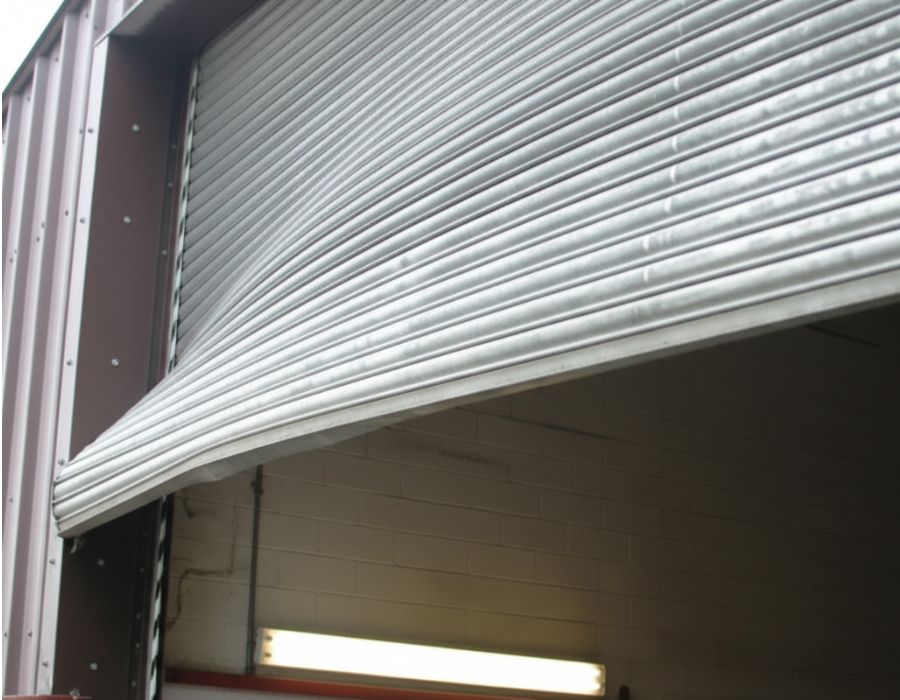
Minor debris can be cleared with a cloth or small brush. Bent or misaligned tracks need professional attention. Forcing a door to operate on a bent track will accelerate roller wear and can damage the door panels themselves.
AJ Services Group handles track realignment jobs throughout the Greater Sydney area, including Western Sydney properties where dusty conditions mean debris buildup is a more common issue.
Know When the Problem Is the Motor or Springs
Some grinding noises do not come from the door mechanics at all. They come from the motor unit or the spring system. These are the situations where you should call a professional immediately.
Motor-related grinding usually sounds like it is coming from the ceiling mounted unit rather than the door itself. You may notice the motor running but the door moving slowly or barely at all. This is often a worn drive gear inside the motor head.
Common motor brands used in Australian roller door systems include B&D, Merlin, ATA, and Steele. Drive gear kits for these units cost between $30 and $80 for parts, but the labour involved in accessing and replacing them means a total repair bill of around $150 to $300.
Spring problems are more serious. Torsion springs and extension springs are under extreme tension. A spring that is failing will produce a deep grinding or creaking sound. If you hear a sudden loud bang followed by the door becoming very heavy to operate, a spring has likely broken. Stop using the door and call AJ Services Group or a licensed technician straight away.
Spring replacement in New South Wales should only be carried out by a qualified tradesperson. This is not a safety recommendation, it is a practical one. The stored energy in a broken spring can cause severe injury to an untrained person attempting the repair.
FAQs on Roller Door Grinding Noises
Is a grinding roller door dangerous to use?
It depends on the cause. A grinding noise from dry rollers or minor debris is not immediately dangerous, but you should still fix it promptly. If the grinding is accompanied by the door sticking, jerking, or becoming hard to operate, stop using it and get a technician to inspect it. A failing spring is a safety risk.
How much does it cost to repair a grinding roller door in Sydney?
A basic lubrication and inspection service typically costs between $80 and $150. Roller replacement ranges from $150 to $350 depending on the number of rollers and door size. Track realignment sits around $200 to $400. Spring replacement is usually $250 to $600 for parts and labour. These are general Sydney market figures and can vary.
Can I lubricate my roller door with WD-40?
Standard WD-40 is a water displacer and light solvent, not a long-term lubricant. It will reduce grinding temporarily but dries out quickly and can attract more grime. Use a silicone spray or white lithium grease for lasting results. Products like Inox MX3 are popular choices among Australian tradespeople.
How often should I service my roller door to prevent grinding?
A basic lubrication and visual inspection every six months is a good habit. In coastal Sydney suburbs, every three to four months is better due to salt air. A full professional service including track check, spring tension assessment, and motor test is recommended once every two years.
My roller door is grinding only in cold weather. Why?
Cold temperatures cause metal to contract slightly, which tightens tolerances between rollers and tracks. It also thickens lubricants, reducing their effectiveness. If grinding only happens on cold mornings and disappears once the door warms up, a fresh application of low-viscosity lubricant suited to temperature changes will usually resolve it.
Who do I call for roller door repairs in Sydney?
For electrical roller door repairs, motor faults, and spring replacements in Sydney, a licensed electrical or garage door technician is the right call. AJ Services Group handles roller door motor repairs and electrical faults across Sydney and can diagnose grinding issues on-site. Contact us to arrange a service visit.
Wrap Up and Next Steps
A grinding roller door is telling you something is wrong, and the fix is usually straightforward if you catch it early. Start with lubrication, check the rollers and tracks, and if the noise persists or the door starts misbehaving, get a professional involved before the problem gets worse.
AJ Services Group provides roller door motor repairs, electrical fault diagnosis, and maintenance services across Sydney. If your door is grinding and you are not sure where to start, give our team a call or request a quote online and we will get it sorted.